
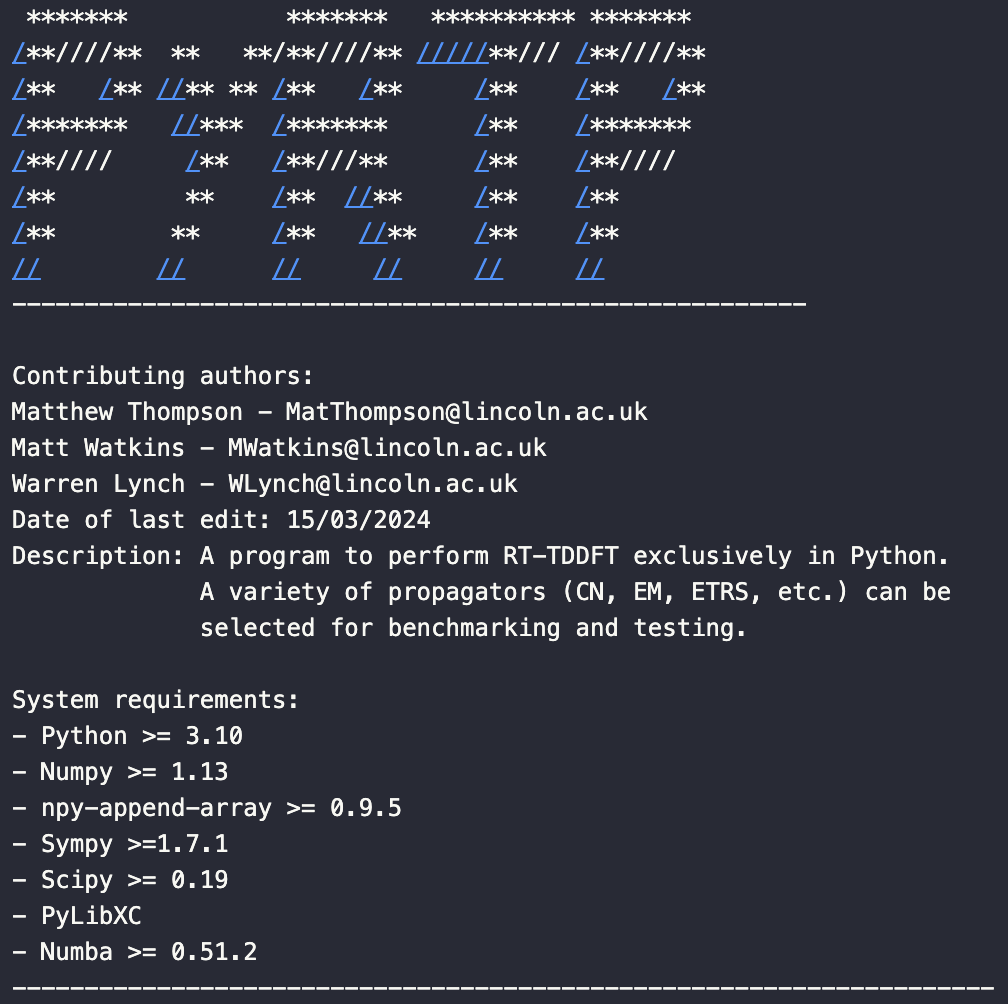
Objective: develop a program to perform real-time time dependent density functional theory calculations as simply as possible.
During the devlopment of the code for the Optimisation of RT-TDDFT methods in CP2K project, it was found that the program was easy to read and accessible for undergraduate students. Many DFT codes, owing to the push for greater efficiency and accuracy, have source code which is either unaccessible (closed-source) or extremely unfriendly for non-technical people (i.e. students who are not strong programmers). On top of this, many DFT codes are written in programming languages which are not simple to follow (i.e. C, Fortran, etc.). For many students, looking at exactly how a code calculates values is beneficial, and thus, the project was designed to produce a code to do this.
In order to complete this project, the program had to be designed with the following considerations in order to achieve the aims set out:
In order to do this, the following programming decisions were made:
This project is publically accessible on GitHub, and is maintained by myself. There are a number of things that I would like to continue to work on, however I do not presently have the time to continue development alone. If you would be interested in working on this project, please get in touch!
This work was also presented at the CCP9 Conference 2024, with this poster.